
Custom Trailer Pros Draft · Sep 2026

Knowledge Base draft

Food Trailer Readiness Scorecard. Results copy for your review.

Know Your "Why"

Do you know why you’re doing this , and will that reason survive the hard weeks?

Diagnosis

Every great business starts as a great idea, and food trucks are no different. We often hear, “My food is amazing, and everyone tells me I should sell it!” That’s a wonderful place to start, but like any business, starting a food truck will come with challenges. At some point, you are likely to face discouragement and setbacks. Understanding your deeper reasons as to why you are doing this will be a helpful motivator for pushing through and overcoming the challenges that lie ahead. Share your “why” with some people close to you so they can remind you of your purpose when things get tough. While this can feel like a small thing, being able to overcome hurdles that are in your way is often the difference between those who make it in this business and those who don’t, so keeping your motivation up during difficult times can be critical.

When this Pillar is weak, people quit too early, or they open undercapitalized and never get a fair shot. Ask yourself: if the next ninety days are slower than you hope, do you still know why you’re here, and do you have runway to learn?

Tips

  • Write out your why

    Not “I love to cook.” The why that survives a cold Tuesday with three tickets. Put it in one paragraph and share it with someone who can help hold you accountable when things get tough.

    Example

    “I want to start a food truck because I want to build something meaningful for my family and myself. I want my children to know that their dreams are worth chasing, and the best way I can show them that is by chasing mine. I know it will be hard, but like everything that is good, I also know it is worth fighting for.”

This week

Block out 30 minutes. Write your one-paragraph “why” and share it with 1–3 people who can remind you of your “why” when things get tough. If you will be operating with a significant other, this step should be done together.
Buying smart

Are you protecting yourself before you write a check?

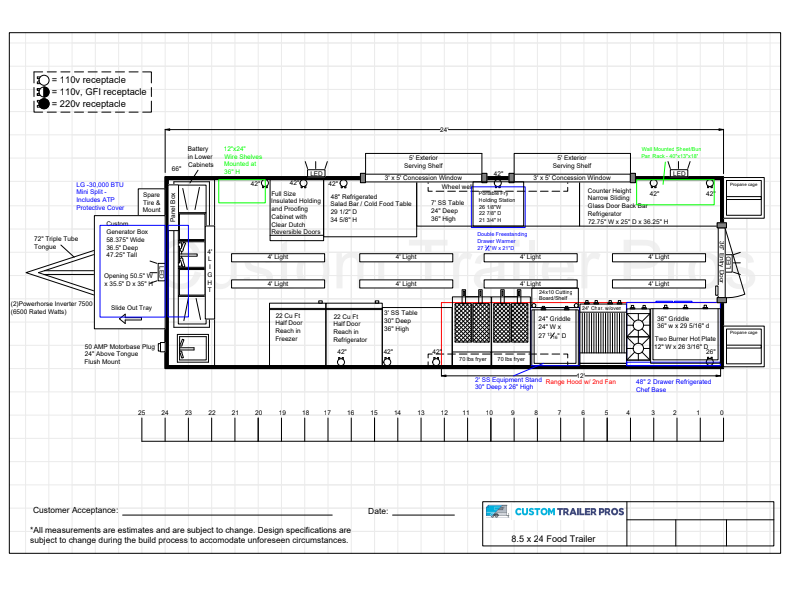
Example Custom Trailer Pros floor plan for an 8.5 by 24 food trailer

Diagnosis

The mobile food industry attracts passionate buyers, and people who will take advantage of them. Garage builders, “deposit today or lose it” pressure, disabled reviews, used units with title problems: most rip-off stories could have been avoided with about ten minutes of research.

Buyers also skip diligence on who they buy from and whether a truck or a trailer actually fits their plan, then blame the industry when the unit does not match how they work.

When this Pillar is weak, people lose money before they ever serve a plate, or they buy the wrong style of unit because a salesperson pushed what they had. Know your codes is its own pillar. Weak there disqualifies just as fast. If you’re not a good fit for a food trailer, a good dealer will say so. Ask: would I still buy this if I slowed down for a week of diligence?

Tips

  • Research the builder like a hire

    Look for real reviews, real facilities, and owners who will answer hard questions. If the company doesn’t allow customer reviews, that’s an immediate no. Visit if you can. Verify used titles and VINs with the authorities. Don’t buy sight-unseen on a handshake story.

  • Truck vs trailer on purpose

    Don’t force a trailer because it’s what a dealer sells, and don’t force a truck because it’s what you pictured. Match the unit to tow capacity, parking, power, and how you actually work. Integrity over close: the right product is the one that fits.

  • Reject urgency theater

    Deposit-now scarcity, mystery pricing, and “we’ll fix codes later” are patterns to walk away from. Slow the purchase down when you think you’re ready but you’re actually not.

This week

Block 60 minutes. Write a one-page buyer checklist: builder reputation checks, new vs used rules, and truck-vs-trailer fit criteria. Use it on every conversation, including ours, before any deposit.

Know Your Codes

Have you talked to health, fire, and zoning before you fall in love with a floor plan?

Diagnosis

It is easier to get forgiveness than permission in a lot of life. When it comes to health codes, that is not the case. Most expensive trailer mistakes happen before the first plate is served: buying a unit that passed inspection somewhere else but fails locally, parking where zoning won’t allow you, or skipping commissary rules that decide whether you can operate at all.

New operators treat codes like paperwork at the end. In practice, codes decide whether your build is legal, whether you can park where you need to, and whether rework will eat another ten to fifteen thousand dollars after you thought you were done. A property owner’s handshake is not a permit. “Passed elsewhere” is not approval here.

When this Pillar is weak, people deposit on a dream layout that an inspector will reject, or they discover proximity rules after the trailer is in the driveway. CTP sees this constantly, and invests real time helping operators get it right before build. Ask: if I called my city and county health offices tomorrow, would I know what to ask, or would I be guessing from a Facebook thread?

Tips

  • Talk to regulators before you buy

    Contact local health and fire officials early. Build the relationship before you need a favor. Ask what layouts, equipment, and commissary arrangements they expect in your county, not in the state where the used unit was “approved.”

  • Pre-approve the layout

    Before you fall in love with a floor plan, learn what your city and county require. Pre-approve layouts with people who know the rules. If research makes you want to quit, that can be a healthy exit. Better now than after a deposit.

  • Map zoning and proximity, not just health

    Health can pass while city permit blocks you: restaurant proximity, signage, hours, or land use. Walk the pad with code questions, not only taste-test dreams.

  • Pick a builder who speaks code

    Codes help you choose a partner who can build to local requirements the first time. “We’ll fix codes later” is a pattern to walk away from.

This week

Block 60 minutes. Write a one-page code checklist: health, fire, commissary, zoning, and proximity questions for your target operating area. Call or email one official with three specific questions. Do not put money down until you have answers in writing or from a qualified consultant.

Run the Numbers

Can you tell if this is a viable business, not just a passion project?

Diagnosis

People aren’t really asking how much food trucks make. They’re asking whether this can work as a business. The ones who fail often never learn the difference between recipe cost and real food cost, or between a busy night and a profitable month.

A classic trap: you buy a hot dog for a dollar, sell it for three, and call it two dollars of profit. Overhead still has to get paid. Owner meals and giveaways that never hit the register create phantom losses. If you only watch food cost vibes, you can’t diagnose why the bank account is empty.

When this Pillar is weak, pricing is a guess, “we’re busy” hides a slow bleed, and every problem looks like a marketing problem. Fill a gap in your market or be the absolute best at what you’re going to do. Either way, the math has to close. Ask: if I stopped cooking for a day and only looked at the numbers, would I know what to fix?

Tips

  • Separate recipe cost from food cost

    Recipe cost is the kitchen-table build (ingredients, wrap, napkin). Food cost is opening inventory plus purchases minus ending inventory over a real sales period. Track both. If recipe math says ~25% and actual lands at 30-35%, hunt the gap (yield, waste, portions, unringed food).

  • Build a full overhead picture

    Labor, fuel, commissary, insurance, payments, marketing, repairs. Not just COGS. Price so the business survives a normal week, not a dream festival Saturday.

  • Ring everything

    Owner comps and free plates still move inventory. If it leaves the window, it should hit the system or your counts will lie to you.

  • Use simple targets

    You don’t need a CFO dashboard on day one. You need weekly counts, a break-even sales number, and a habit of asking “what changed?” when results miss plan.

This week

Block 90 minutes. Cost your top three menu items as recipes (including wrap and waste assumptions), then draft a one-page monthly overhead list and a break-even sales target. Bring those numbers to any quote or build conversation.

Menu focus

Is your menu built to make money and move fast, or to impress everyone?

Diagnosis

New operators often build a Cheesecake Factory board on a mobile footprint: fifteen burgers, four proteins, something for everyone. It feels generous. It creates waste, slow tickets, no niche, and a customer who remembers nothing.

Creating great food is only the beginning. Pair the menu down to what you specialize in and build around that. Radical niching beats variety theater. Five main sellers is already a lot; ten’s too many. Guests will tell you what works if you listen, even when that means your favorite dish is an ugly baby and has to go.

When this Pillar is weak, prep never ends, ticket times blow up, and marketing has nothing clear to say. Ask: if a stranger had thirty seconds with your menu, would they know what you’re the best at?

Tips

  • Cap the mains

    Start near five hero items or fewer. Create variety inside one format (burgers, tacos, bowls) so the board feels bigger than the SKU count. Kill losers without guilt.

  • Cost before you fall in love

    Passion can pick the starting dish. Profit and yield decide if it stays. Test on strangers, not only family. If kids’ side dishes outsell your signature, believe the data.

  • Engineer the board

    Put high-profit, fast items where eyes land (the “golden triangle”). One clear hero picture beats a wall of photos. If people ask “what you got that’s good?”, the menu isn’t readable yet. Answer with something profitable and quick.

  • Let demand reshape the build

    When one item wins, redesign stations and even the trailer around it. That’s how second units get earned, not by adding forty more SKUs.

This week

Block 60 minutes. Write a draft menu with five or fewer mains, mark the one hero, and note which two items you’d cut first if ticket times slip. Bring that draft to any layout conversation.

Speed of service

How quickly can you serve food once it’s been ordered?

Stainless kitchen interior of a Custom Trailer Pros food trailer

Diagnosis

Plates per minute is the make-or-break idea in mobile food. Great recipes don’t pay the bills if every ticket takes five minutes to fulfill. In a mobile environment, that pace will not survive. People gravitate to a faster-moving line, even when the food next door is “better.”

The keys are simple and hard: a workable menu, a one-way workflow, the right equipment for that menu, and prep that stays ahead without killing freshness. The food should move, not the employees. Order and pickup should not fight for the same square foot. You can’t be an efficient owner if you’re stuck cooking and cashiering every ticket.

When this Pillar is weak, festival dreams turn into melted lines, refunds, and one-star “slow” reviews that no recipe can fix. Ask: if twenty people showed up right now, would plates leave the window every minute, or would the line freeze?

Tips

  • Design stations on purpose

    Number the flow (order, cook, plate, drinks/out). Stop path-crossing between cook and window. Separate order and pickup when volume matters.

  • Match equipment to the menu

    Big pieces and small ones (warmers, holding, storage) exist to protect speed. Don’t buy a generic kit and hope. Build the box around how food actually leaves the window.

  • Prep for the rush

    Stay a few tickets ahead on the items that hold. Window staff should own no-cook fulfillment (chips, drinks) so the cook never leaves the line.

  • Watch guest patience

    Counter-service reality: around eight minutes is a soft ceiling; past ten, return intent drops fast. “They’ll wait for good food” is how you lose the second visit.

This week

Block 45 minutes. Sketch your trailer or truck as numbered stations and time a mock ticket for your hero item from order to handoff. If you can’t describe the path in one page, you’re not ready to sign off on a floor plan.

Attracting customers

Do you have a system to attract people, or only a place to park?

Finished blue Custom Trailer Pros concession trailer

Diagnosis

Weak marketing kills more new trucks than weak recipes. Posting “we’re open” / “we’re closed,” ignoring comments, and hoping a brewery patio or event promoter will fill the line is not a system. There’s no golden goose location. Empty line is your signal that you need to market.

Raving fans are the best and cheapest marketing you can have. That means showing the setup, asking for reviews, answering people who love you, and building more than one revenue path (events done with research, catering for slow seasons). Ignoring a comment is hanging up on someone who already likes your food.

When this Pillar is weak, great food sits still, winters feel fatal, and every slow day feels personal. Ask: if I couldn’t rely on walk-up traffic tomorrow, how would anyone find me?

Tips

  • Run the marketing train

    Website with a clear next step, Google profile, social, loyalty, reviews. Nearly daily presence on days you care about. Aim for roughly two value posts for every one “buy now” post. Show the setup, not only plate close-ups.

  • Treat comments like customers

    Reply. Thank them. Tell them where you’ll be next. “I’m closed” alone is a negative; pair it with the next open and a reason to come back.

  • Make reviews easy

    A simple card or QR path: problem → message you; love it → leave a review. Ask after a win, not only when you’re desperate.

  • Research events and add catering

    Ask organizers about marketing budget and social reach. Check other vendors’ history. Avoid blind deposits. Build catering (drop-off → buffet → full service) before winter owns your calendar.

This week

Block 60 minutes. Audit your Google profile, last ten social posts, and review-ask process. Fix one broken link in the train (profile, pinned location post, or review QR) and schedule seven days of posts that include where you’ll be next.

Execution

Are you measuring what happened, and changing something because of it?

Diagnosis

A lot of operators work hard and still repeat the same week. They don’t compare sales to a plan, don’t time the line, and don’t admit what’s not working. All data is good data, but all of that’s useless if you don’t actually do something.

Build, measure, learn isn’t a slogan for startups only. It’s how you keep a mobile business alive: try a change, watch tickets and dollars, keep what works, kill what doesn’t. Speed of service, menu mix, and marketing posts all leave clues. First two great visits often create a lifetime customer, so the “first timer” path is worth designing on purpose.

When this Pillar is weak, ego protects the menu, the layout, and the schedule while the bank account votes no. Ask: what did I change this week because of a number or a guest comment?

Tips

  • Pick a few weekly measures

    Sales vs plan, average ticket time, top sellers, and one guest-feedback theme. Enough to steer, not a spreadsheet hobby.

  • Run small experiments

    Change one thing (prep, station, post type, hero placement). Give it a fair window. Keep or reverse based on evidence, not vibes.

  • Design the first-timer wow

    Know what a new guest should feel in the first two visits. Script the greeting, the suggest (round out the meal, don’t annoy with endless add-ons), and the review ask.

  • Stay coachable

    Mentors, associations, and other operators only help if you put the lesson into next week’s shift. Education without action is entertainment.

This week

Block 45 minutes. Choose three measures you’ll track for the next fourteen days, write them on one page, and pick one experiment you’ll run (menu, speed, or marketing). Put both on the calendar so they actually happen.

Quiz questions draft

Evidence-based qualification for pre-purchase leads thinking about buying a food trailer. Questions sit under each pillar. Each answer scores 0–10. Questions tagged Disqualifier can flag unfit leads while they still get Results.

28 questions8 pillarsPre-purchase~5–8 min

Answer score key

  • 0 None
  • 3 Low (2–3)
  • 5 Mid (4–6)
  • 8 High (7–9)
  • 10 Strong

Know Your "Why"

Have you written your why in one paragraph?

  • Yes, written down10
  • Not yet0

Have you shared it with someone who'll remind you when it gets hard?

  • One person7
  • Two or three people10
  • Not yet0

Will a partner or spouse run this with you?

  • Solo operator10
  • Yes, we're aligned10
  • Not sure3
  • Yes, not yet discussed0

What's the main reason you're starting?

  • People love my food0
  • My own schedule4
  • Building something for my family10
  • Replace or add income7

Menu focus

How many core mains on your draft menu?

  • 4 or fewer10
  • 5 to 67
  • 7 to 94
  • Still deciding or 10+0

Have you costed your top sellers?

  • One item4
  • All top sellers, written10
  • Not yet0
  • Two or three7

Have you served this menu to paying strangers?

  • Friends and family only3
  • Once or twice, paying6
  • Multiple times10
  • Not yet0

Run the Numbers

Disqualifier What's your budget for the trailer?

  • Below $30,000 (without cooking equipment)0
  • $30,000 to $35,0003
  • $35,000 to $45,0005
  • $45,000 to $55,0007
  • $55,000 to $65,0008
  • $65,000+10

Do you need help with financing?

  • Yes7
  • No10

Do you know your monthly break-even sales number?

  • Rough guess4
  • No0
  • Written number10
  • Calculated, not written7

Have you costed your top 3 menu items as recipes?

  • All three10
  • One3
  • Not yet0
  • Two5

If sales are slow the first 90 days, how long can you run?

  • One to three months6
  • Three months or more10
  • No idea0
  • A few weeks2

Buying smart

Have you researched builder reviews and references?

  • Called or emailed owners7
  • Not yet0
  • Online reviews only4
  • Visited or verified10

Have you chosen truck vs trailer for your plan?

  • Leaning truck4
  • Leaning trailer6
  • Not decided0
  • Decided with reasons10

Do you have a written buyer checklist before any deposit?

  • Yes, written10
  • Not yet0

Know Your Codes

Have you contacted your local health department?

  • Researched online only3
  • Emailed6
  • Spoke with someone10
  • Not yet0

Do you know commissary requirements for your area?

  • Heard rumors only3
  • Not yet0
  • Confirmed10

Have you checked zoning where you plan to operate?

  • Looked online4
  • Asked one official7
  • Not yet0
  • Confirmed in writing10

Have you pre-approved your layout with code officials?

  • Yes, in writing10
  • Not yet0

Speed of service

Have you sketched station flow for your menu?

  • Rough sketch5
  • Numbered one-page flow10
  • Not yet0

Have you timed your hero item from order to handoff?

  • Yes, timed it10
  • Not yet0

Will order and pickup use separate windows or stations?

  • Separated10
  • Same window or not planned3

Attracting customers

Have you reserved your business name and checked Google/social handles?

  • Name only3
  • Name plus some handles7
  • Name and handles secured10
  • Not yet0

Have you researched where you'll sell before you buy?

  • General ideas only3
  • Short list started7
  • Written target list10
  • Not yet0

Do you have a plan to ask for reviews once you open?

  • Yes, planned10
  • Not yet0

Execution

Do you have a written launch timeline with milestones?

  • In my head only3
  • Rough dates on paper7
  • Written timeline10
  • Not yet0

Have you adjusted your plan after research or operator conversations?

  • Yes, updated my plan10
  • Not yet0

Talked to another operator this month?

  • Online only4
  • Real conversation10
  • Not yet0